
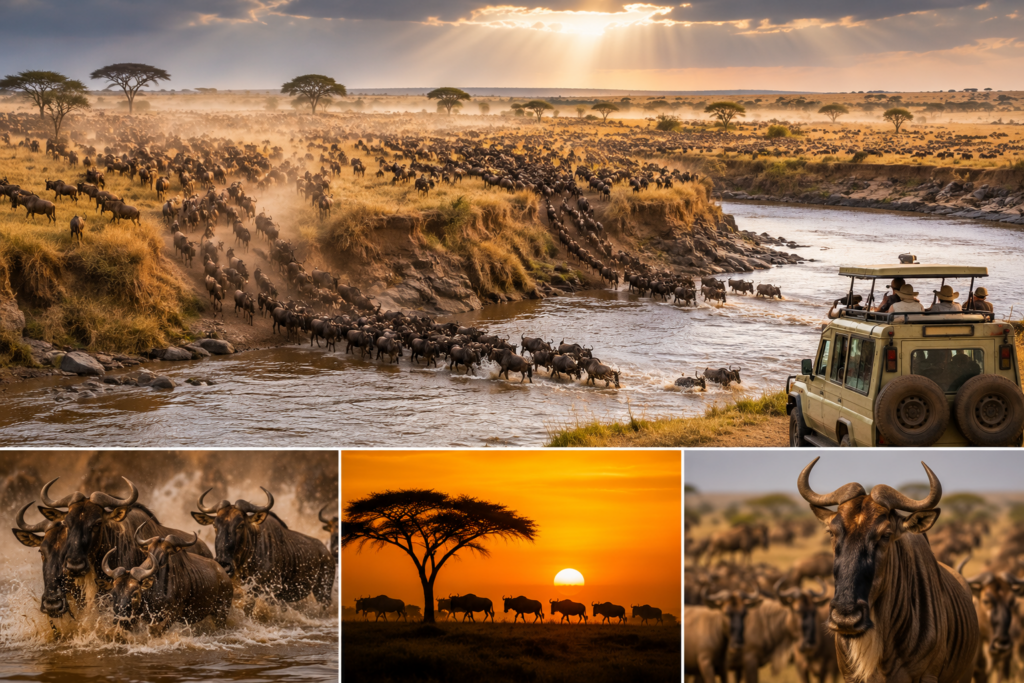
Every year, over 1.5 million wildebeest, 200,000 zebras, and 500,000 gazelles make the most dramatic journey on Earth — a 1,800-kilometre loop across the Serengeti-Mara ecosystem that has earned the title of one of the Seven Natural Wonders of the World. If you’ve ever wanted to witness the great wildebeest migration in Kenya’s Masai Mara, this guide covers absolutely everything you need to know to plan your trip in 2026.
And here’s the thing most people don’t realise: the migration isn’t a single event. It’s a year-round cycle, and knowing when to go and where to be makes all the difference between an incredible experience and “we saw some wildebeest in the distance.”
What Exactly Is the Great Migration?
The Great Migration is the largest overland animal movement on the planet. It’s not a migration in the traditional sense — these animals don’t travel from Point A to Point B and stop. Instead, they follow a clockwise loop driven by rainfall and the search for fresh grazing.
The cycle moves roughly like this:
- December – March: Calving season in the southern Serengeti (Tanzania). Around 500,000 calves are born in a roughly three-week window — nature’s way of overwhelming predators with sheer numbers.
- April – May: The herds begin moving northwest through the Serengeti’s Western Corridor as the southern plains dry out.
- June: The massive columns of wildebeest approach the Grumeti River — the first major water crossing, complete with enormous Nile crocodiles.
- July – October: The herds cross into Kenya’s Masai Mara Game Reserve — this is the peak season and the most dramatic phase of the entire migration.
- November: Short rains begin in the Serengeti, drawing the herds south again to restart the cycle.
The Mara River Crossings: Nature’s Greatest Spectacle
If there’s one image that defines the great migration, it’s the Mara River crossing. Thousands of wildebeest gather on the riverbank, building courage for hours — sometimes days — before suddenly plunging into the churning waters. Crocodiles wait. Currents sweep animals away. The weak don’t make it. It’s raw, unscripted nature at its most intense.
Here’s what you need to know about witnessing a crossing:
Where Do Crossings Happen?
The Mara River snakes through the reserve, and crossings can happen at various points. The most famous crossing sites include:
- Look-Out Hill Crossing — one of the most photographed spots, with steep banks that create dramatic descents
- Serena Crossing — near Serena Lodge, wide and relatively accessible
- Main Crossing Point — the most popular, often with multiple vehicles gathered
- Purungat Bridge area — less crowded, excellent for photographers wanting cleaner shots
When Do Crossings Happen?
There is no schedule. Crossings are triggered by herd pressure, water levels, predator activity, and sometimes just one brave wildebeest who decides to go first. Your guide’s experience and positioning are everything — which is why choosing a reputable safari operator matters enormously.
The peak crossing period is typically late July through September, but crossings can occur from June through November. Some years, the herds cross back and forth multiple times.
Month-by-Month Migration Guide for the Masai Mara
July: The Arrival
The first herds begin arriving in the Masai Mara, usually through the Mara Triangle. The grass is still green, the landscape is spectacular, and the anticipation builds. Early crossings of the Mara River can begin in late July, though they’re less predictable.
Best for: Fewer crowds, lush green scenery, early crossings.
August: Peak Action
This is prime time. The bulk of the herds are in the Mara, and river crossings happen with increasing frequency. Predator activity is at its highest — lions, cheetahs, leopards, and hyenas all take advantage of the abundance. The sky is often dramatic with storm clouds rolling in.
Best for: River crossings, predator action, dramatic photography.
September: The Sweet Spot
Many seasoned safari-goers consider September the best month. The herds are spread across the Mara, crossings continue, and the shorter grass makes wildlife easier to spot. The weather is generally dry and pleasant.
Best for: Best overall migration experience, good weather, excellent visibility.
October: The Return Begins
The herds start moving south again. You’ll still see massive numbers and some late crossings (now heading south across the river), but the urgency shifts. The short rains may begin, turning the landscape golden-green.
Best for: Fewer tourists, good value, still active wildlife.
Best Camps and Lodges for Migration Viewing
Where you stay in the Mara dramatically affects your migration experience. The reserve is divided into several areas:
- Mara Triangle (west): Managed by the Mara Conservancy, less crowded, excellent for crossings. Home to Angama Mara, Sala’s Camp, and several quality tented camps.
- Central Mara: Close to main crossing points, highest concentration of camps. Convenient but busier during peak season.
- Mara North Conservancy: Private conservancy bordering the reserve. Fewer vehicles, more exclusive experience, and off-road driving is permitted.
- Olare Motorogi Conservancy: One of the best private conservancies for big cat sightings. Limited bed nights mean uncrowded game drives.
At Eminent Safaris, we work with camps across all these areas to match your budget and preferences — from comfortable tented camps to luxury lodges. And yes, you can pay in installments, so you don’t need to have the full amount upfront.
What Wildlife Will You See Beyond the Wildebeest?
The migration draws predators from across the ecosystem. During migration season, the Mara offers some of the highest wildlife densities on the continent:
- Lions: The Mara has one of the highest lion densities in Africa. Prides strategically position themselves near crossing points.
- Cheetahs: Open grasslands make the Mara one of the best places in the world to see cheetahs hunt.
- Leopards: Found along riverine forests, especially in the Mara Triangle.
- Nile Crocodiles: The Mara River’s resident giants, some exceeding 5 metres in length.
- Hippos: Hundreds occupy the river pools, adding another obstacle for crossing wildebeest.
- Hyenas: Clans gather near crossing points to scavenge drowned animals.
- Vultures and Marabou Storks: The cleanup crew — nature’s recyclers.
- Elephants, Giraffes, Buffalos: Resident year-round, but the lush migration-season grass draws them into open areas.
Photography Tips for the Migration
Whether you’re shooting on a DSLR or a smartphone, here are tips from seasoned Mara photographers:
- Lens: A 100-400mm zoom is ideal for crossings. Wide-angle (16-35mm) captures the scale of the herds.
- Shutter speed: 1/1000s or faster for crossing action. You’ll want to freeze splashing water and running animals.
- Golden hour: The Mara’s sunrises and sunsets are legendary. Be out early, stay late.
- Patience: At crossing points, you might wait 4-6 hours. Bring water, snacks, and a good book.
- Dust: Bring lens cleaning cloths. The Mara gets dusty in dry season.
- Respect: Keep noise down at crossings. Loud vehicles can spook the herds and prevent crossings.
Common Myths About the Migration — Debunked
Myth 1: “The migration happens in July”
Reality: The migration is a year-round cycle. The Mara phase (most popular with tourists) runs roughly July through October, but there’s never a single “migration month.”
Myth 2: “You’ll definitely see a river crossing”
Reality: Crossings are unpredictable. A 3-day trip gives you a decent chance; a 5-7 day trip makes it very likely. But nature doesn’t run on schedules.
Myth 3: “Budget safaris can’t see the migration”
Reality: Absolutely false. The wildebeest don’t check your hotel rating. A well-positioned budget camp with a knowledgeable guide can deliver an incredible migration experience. Eminent Safaris offers affordable migration packages — including installment payment plans.
Myth 4: “The Serengeti side is better than the Mara”
Reality: Different, not better. The Mara has the dramatic river crossings. The Serengeti has the calving season and wider open plains. Many people do both.
Myth 5: “It’s too crowded during migration season”
Reality: The central Mara crossing points can get busy. But the Mara Triangle and private conservancies offer uncrowded alternatives with the same wildlife experience.
How to Book Your Migration Safari
The best migration trips book out months in advance — especially for August and September. Here’s our recommended approach:
- Book 3-6 months ahead for the best camp availability and rates
- Choose at least 4-5 nights in the Mara to maximise your chances of seeing a crossing
- Consider combining with Amboseli or Nairobi NP for a varied experience
- Ask about installment plans — at Eminent Safaris, you can start paying now and travel later
The Great Wildebeest Migration is not just a safari — it’s a once-in-a-lifetime spectacle that reminds you just how wild and magnificent our planet still is. And you don’t need to break the bank to witness it.
Ready to Witness the Migration?
Our Masai Mara safari packages are designed to put you right in the heart of the action. Budget-friendly options, experienced guides who know the crossing points, and flexible payment plans that let you book now and pay over time.
📞 Call us: +254 704 555 150 | 📧 Email: tours@eminentsafaris.com